CASE STUDY · 01 / 03

Flickrz

A multi-agent AI pipeline that writes, illustrates, and quality-checks Korean webtoon comics — built for a distribution platform with 60M+ readers, with human reviewers holding two hard gates over the whole process.

Role
AI Leader
Team
20 members
Client
Korean webtoon distributor, 60M+ users
Deployment
Internal tool — publishes finished chapters to toomics.com ↗
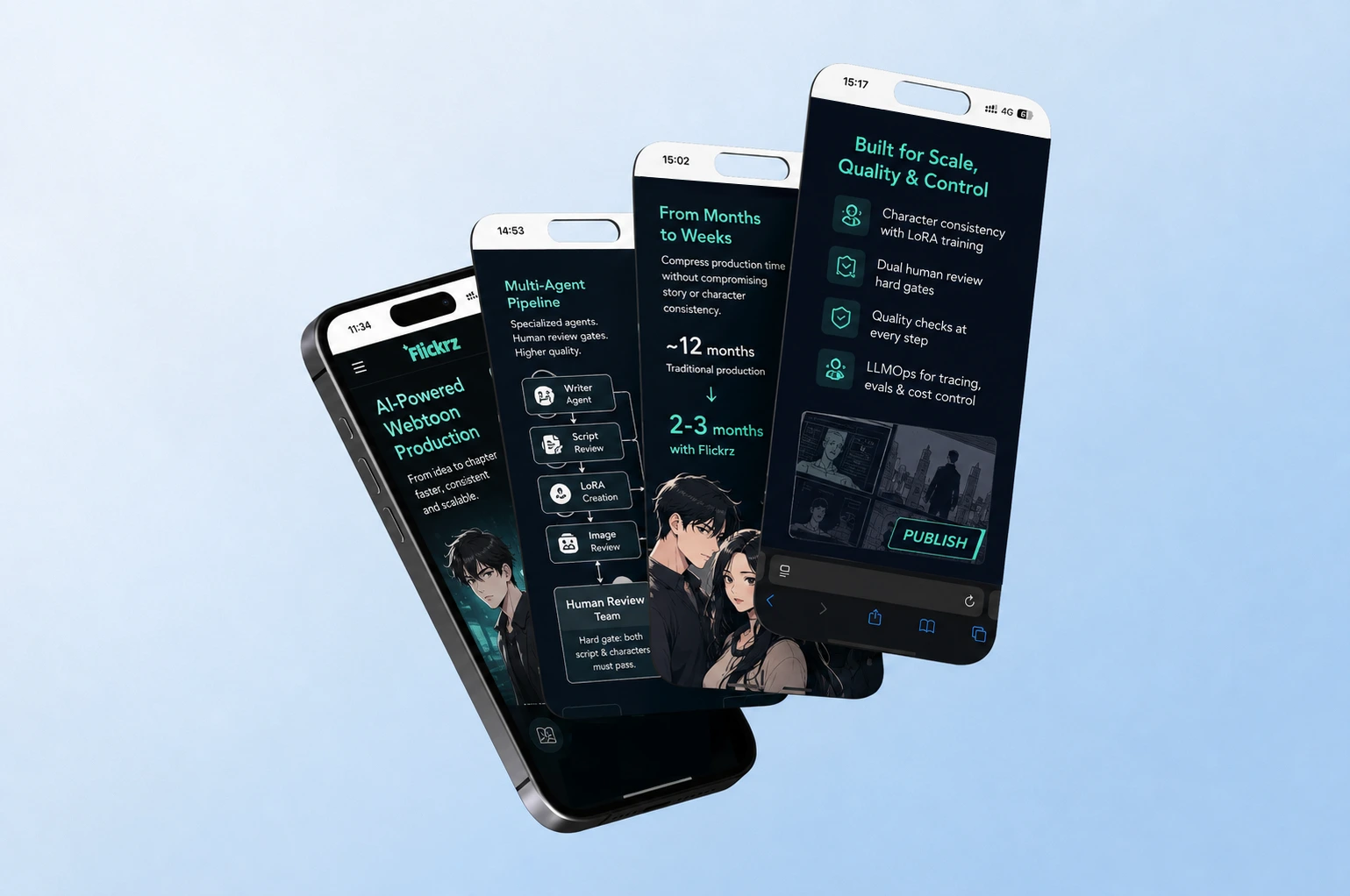
Flickrz app screens — AI-powered webtoon production

01The problem

Before this platform, producing a single webtoon series meant hiring a full production team — writers, artists, editors — and it typically took close to a year per series. The client wanted an AI system that could compress that into a few months without losing what makes a webtoon readable: a compelling script and characters who look like themselves across hundreds of panels.

That second part is the hard one. Generative image models are naturally inconsistent from one generation to the next — the same character prompt can drift in face, outfit, or proportions panel to panel. Any system built for this had to solve character identity as a first-class problem, not an afterthought.

02A multi-agent pipeline, not one big agent

The system is split across several specialized agents, each responsible for one part of the pipeline, with a human reviewer team sitting in the loop as a hard gate before anything expensive happens.

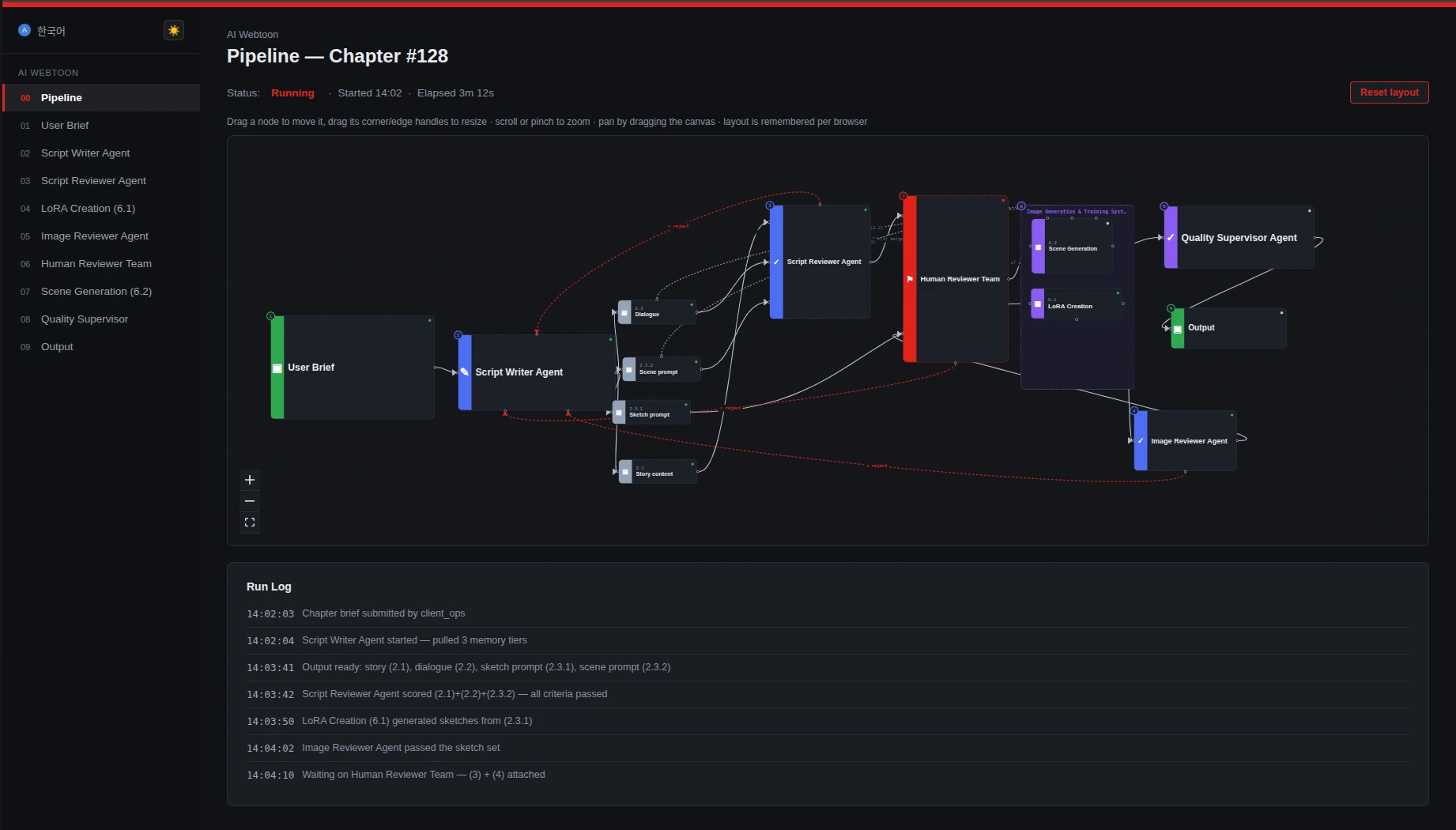
The script side and the character-art side run as two lanes that fork after the Writer Agent and merge twice — once at the Human Reviewer Team gate, once inside the Image Generation & Training System at final rendering. Three separate revise loops (script, sketches, or a human reject) all send work back to the same place: the Script Writer Agent.

User Brief input from client
Genre, target length, and key story beats come in as the seed for a chapter.
Script Writer Agent Reason → Act → Observe
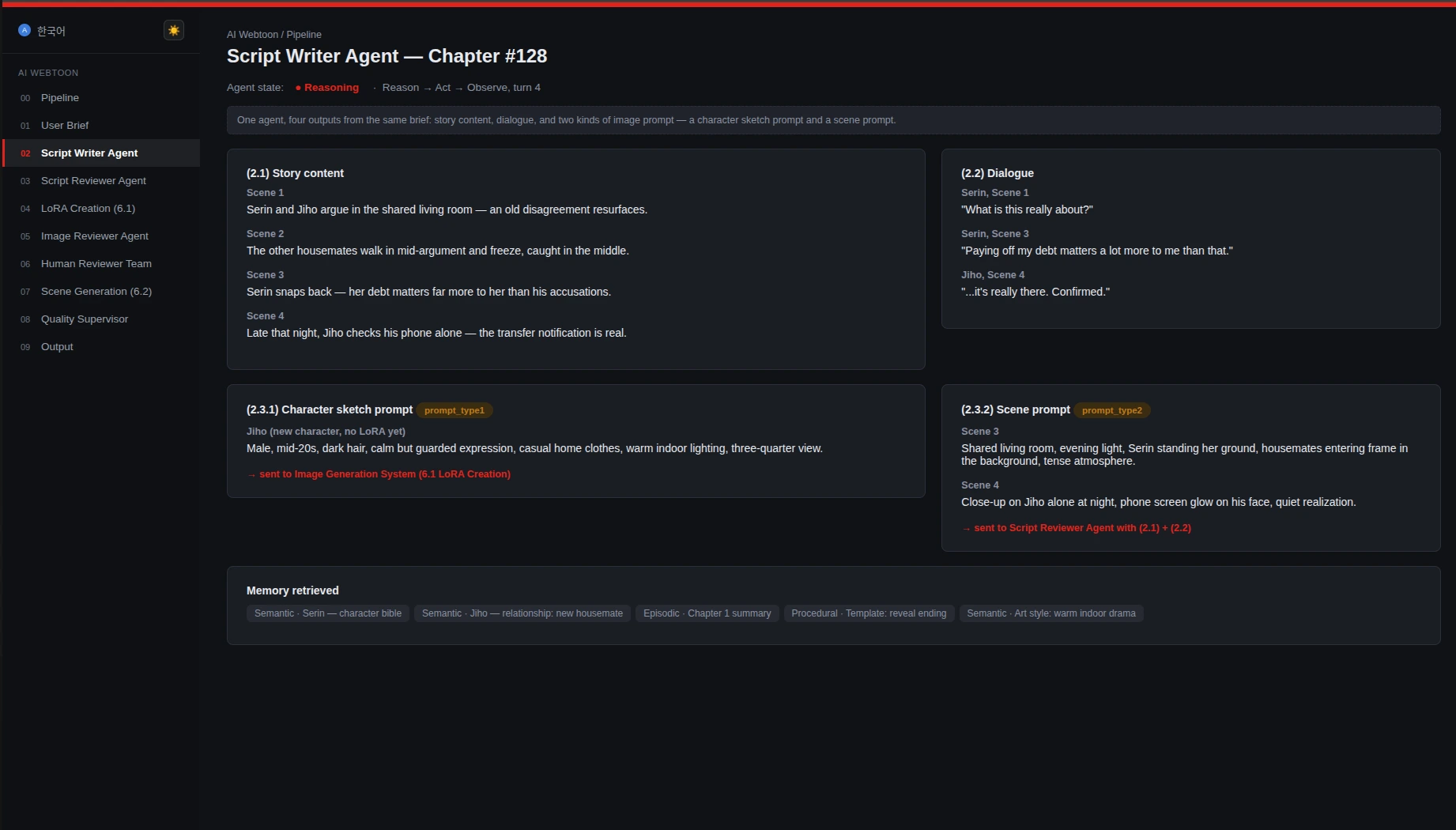
Pulls context from three tiers of memory — semantic (character bibles, world, art style, LoRA registry), episodic (chapter history, reviewer feedback), procedural (writing templates, prompt recipes) — and writes four outputs in one pass: story content, dialogue, a character-sketch prompt (for any character with no LoRA yet), and a scene prompt for rendering.
Script Reviewer Agent rubric-scored · script lane
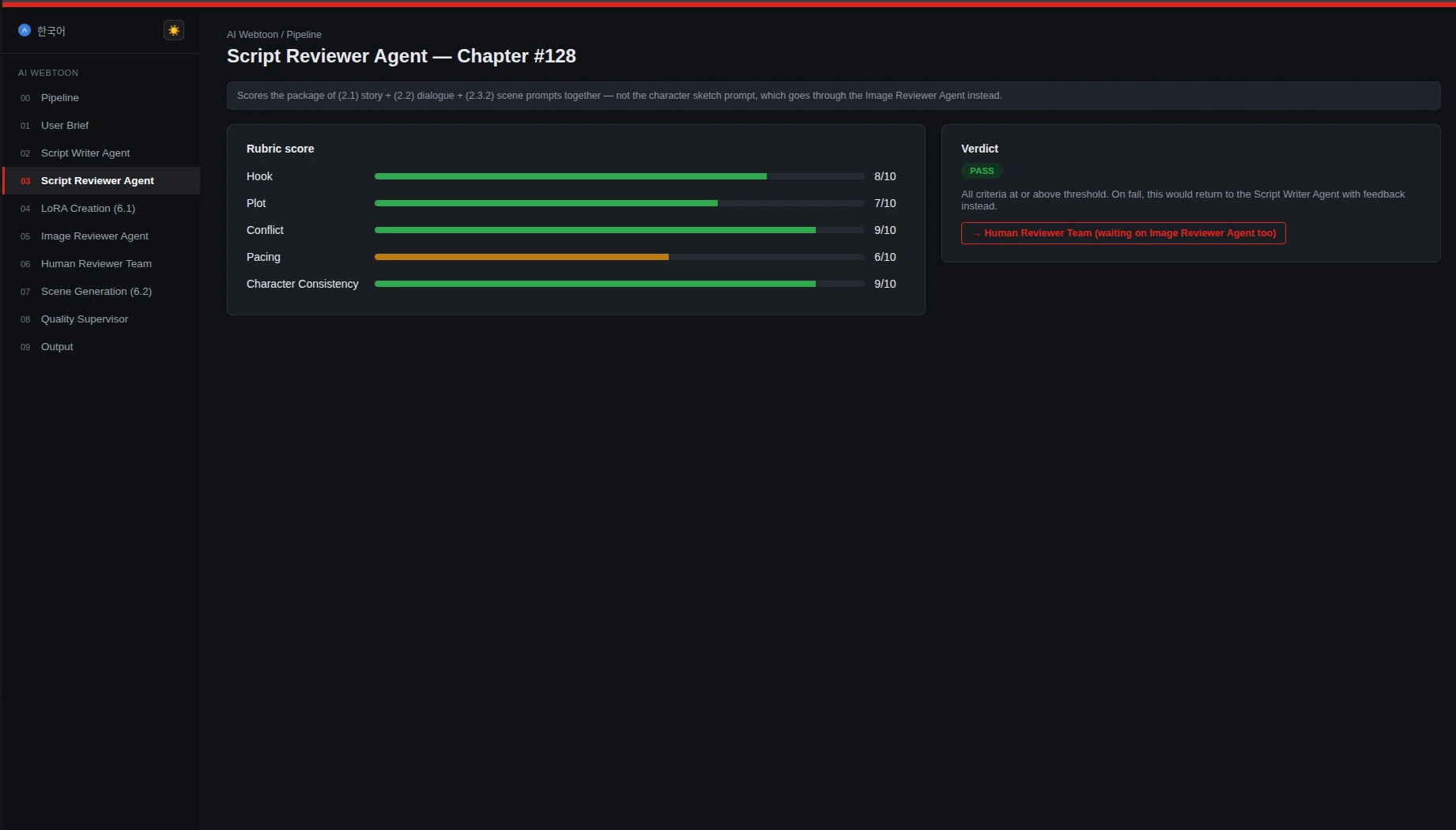
Scores the story + dialogue + scene prompts together against Hook, Plot, Conflict, Pacing, and Character Consistency. Below-threshold drafts go straight back to the Writer Agent with feedback.
LoRA Creation Image Generation & Training System · character lane
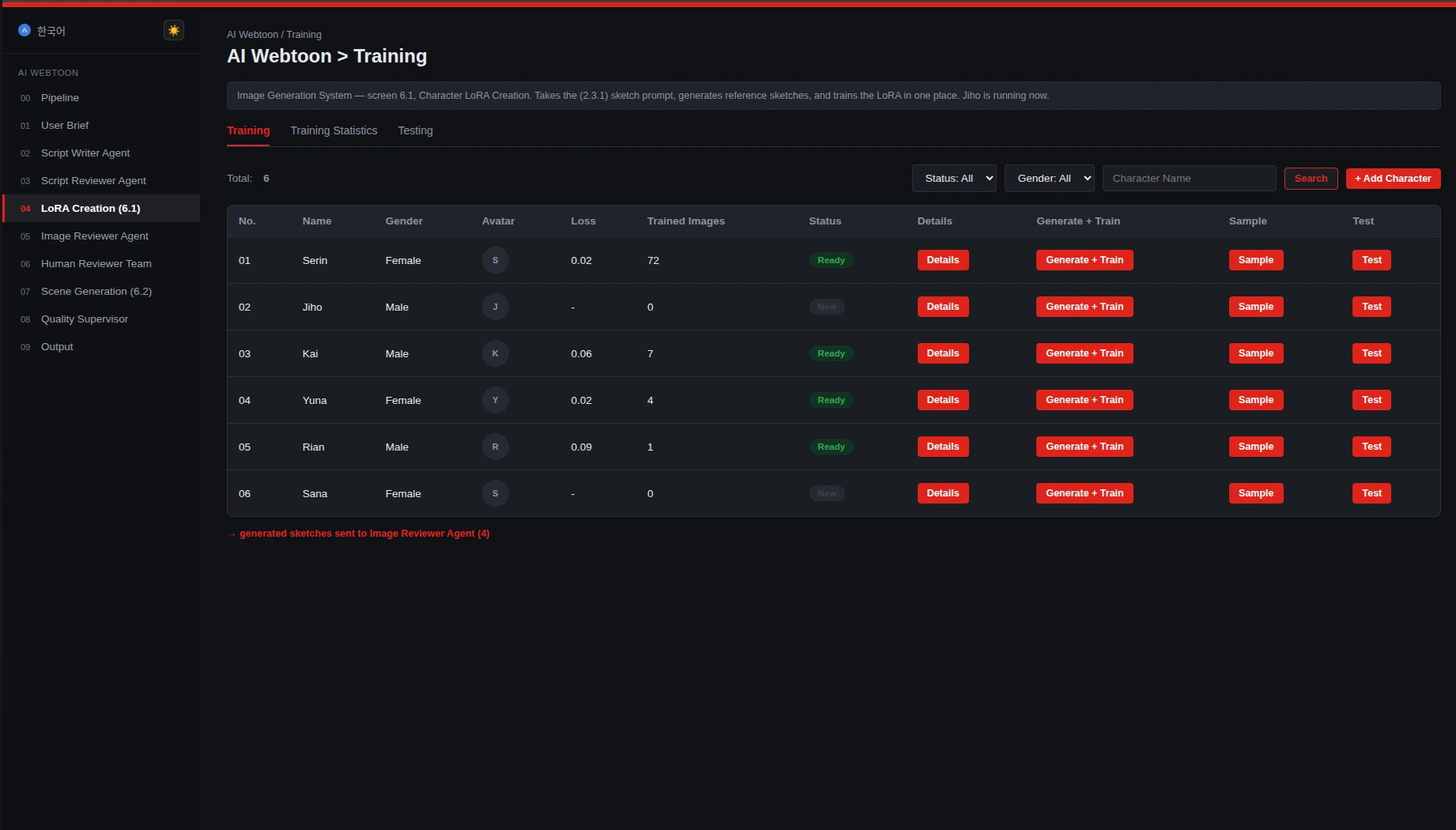
In parallel, the character-sketch prompt enters the Image Generation & Training System — a shared subsystem this screen shares with Scene Generation later. It generates reference sketches via Qwen Image Edit through a custom ComfyUI workflow, then trains the LoRA, for any character that doesn't have one yet.
Image Reviewer Agent character lane
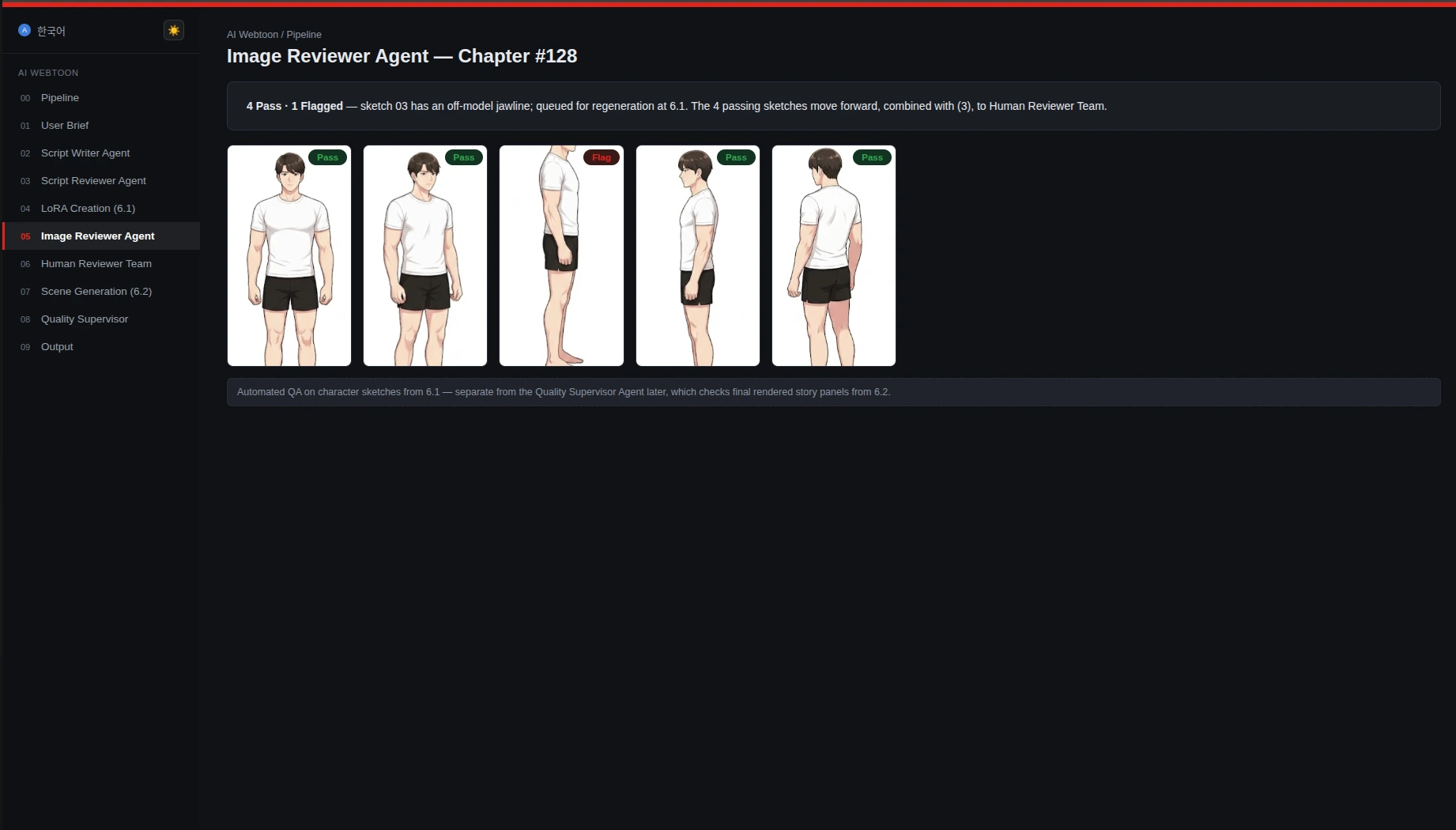
Automated pass/flag on the generated sketches before anything reaches a human — the character-lane counterpart to the Script Reviewer Agent. A flagged batch sends the character branch back to the Script Writer Agent to revise the sketch prompt, same as a failed script review.
Human Reviewer Team hard gate — both lanes merge here
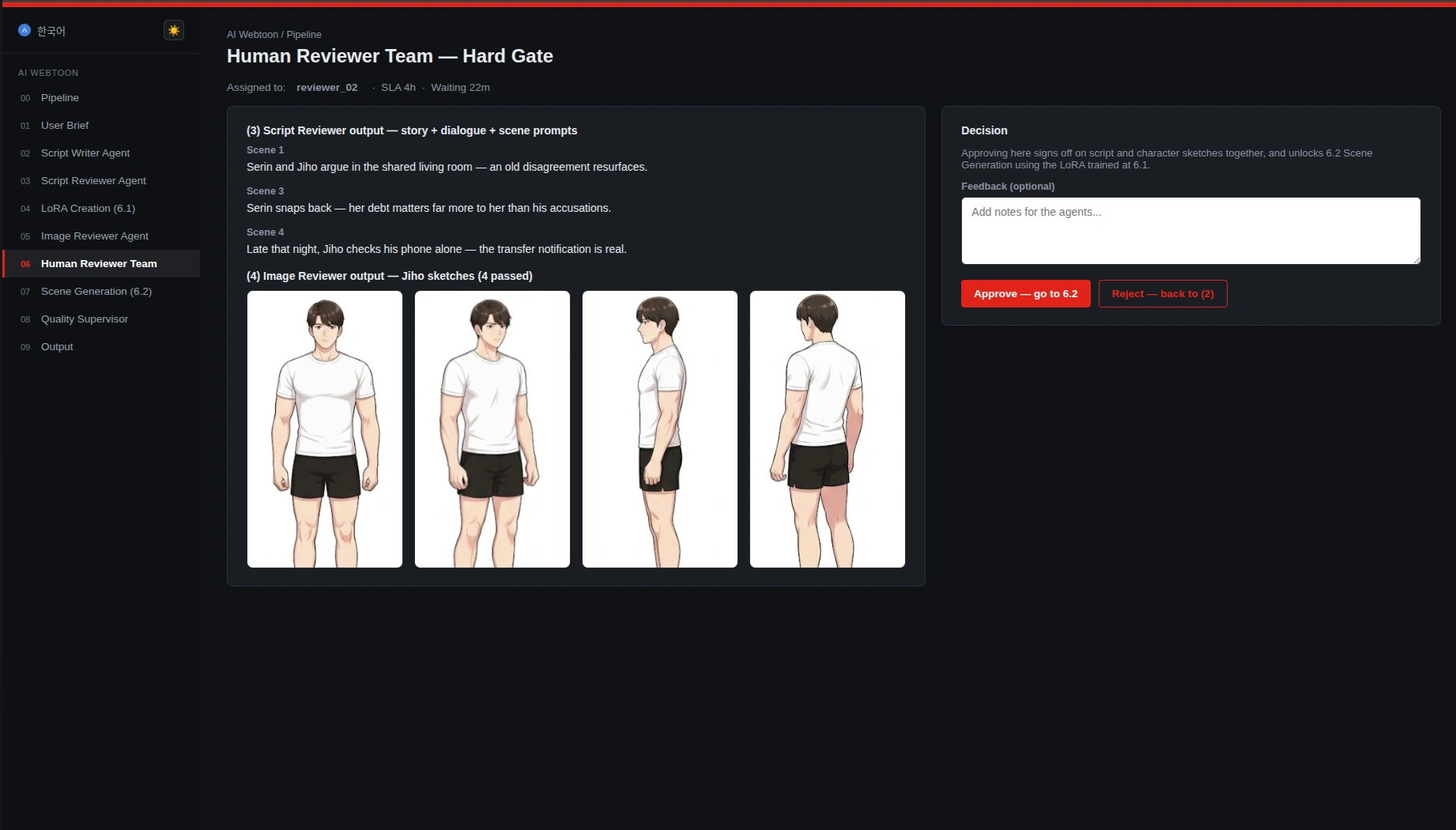
Not optional — the reviewed script and the reviewed character sketches are approved together. Reject sends both back to the Script Writer Agent; nothing renders until this passes.
Scene Generation Image Generation & Training System · second entry point
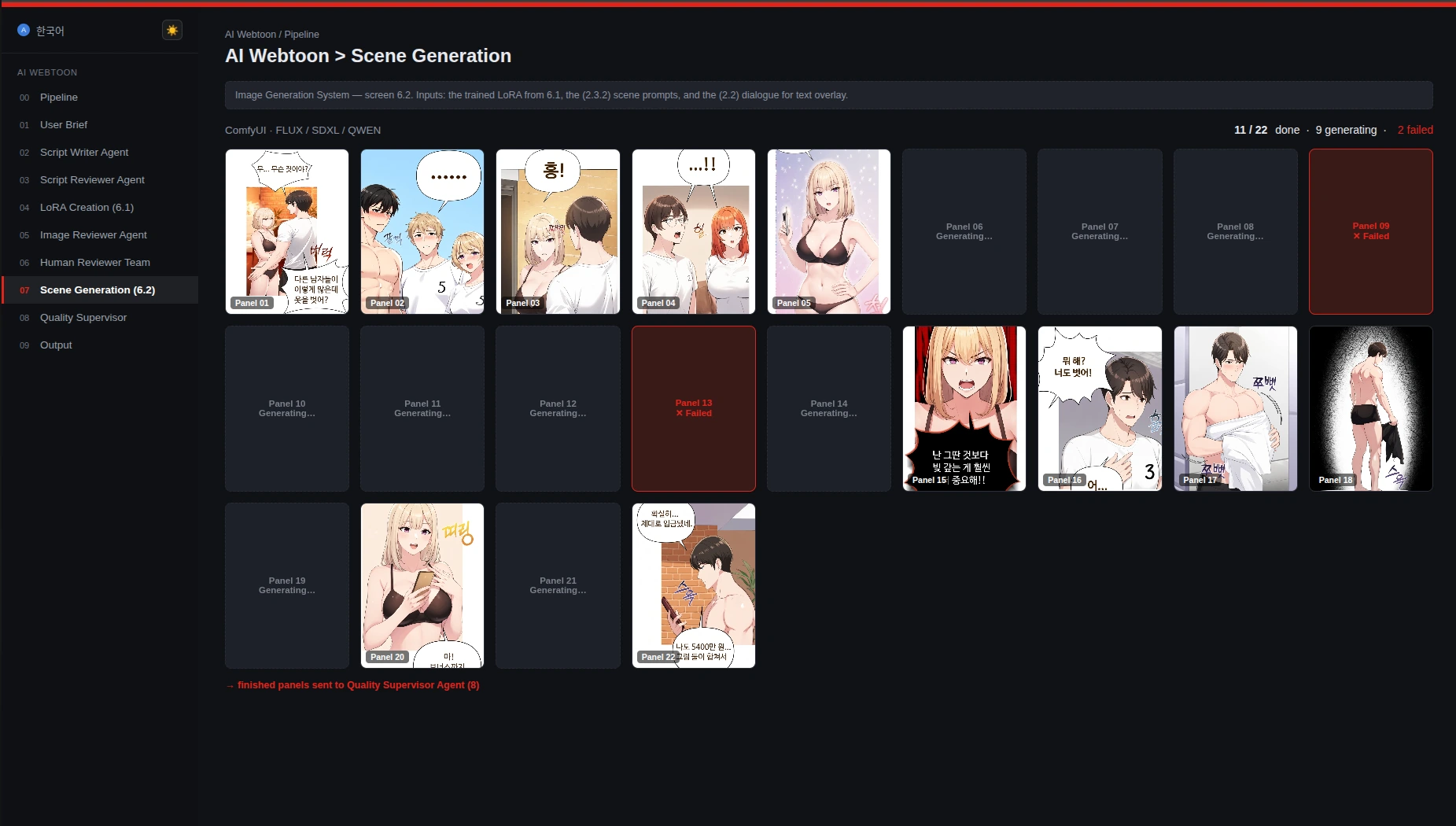
The pipeline's second pass through the Image Generation & Training System — same subsystem as LoRA Creation, this time using ComfyUI with FLUX, SDXL, or QWEN. The trained LoRA, the scene prompts, and the dialogue combine here to render every panel.
Quality Supervisor Agent
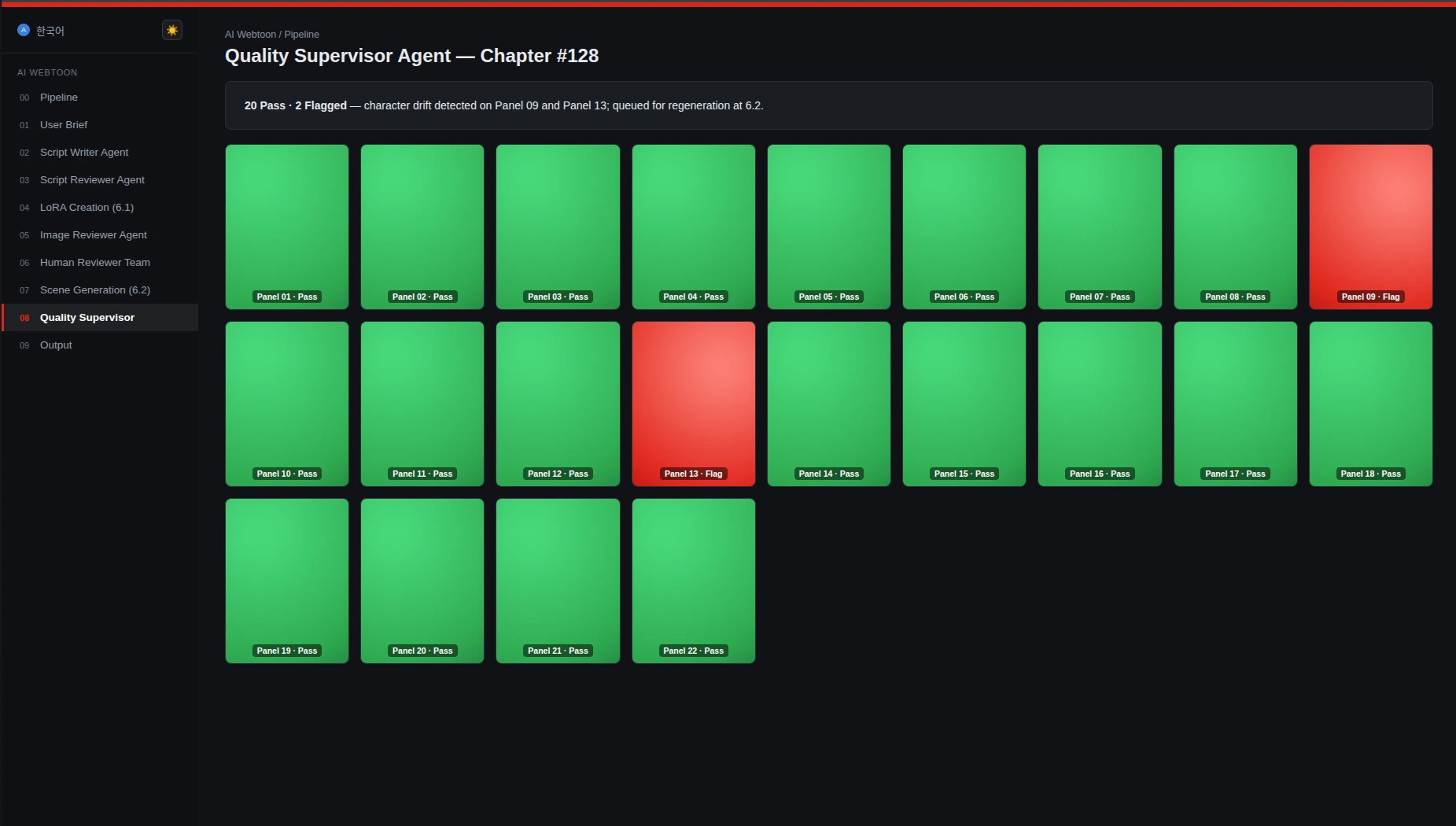
Checks generated panels for quality and consistency; feedback loops back into episodic memory so later runs don't repeat the same mistakes.
Output
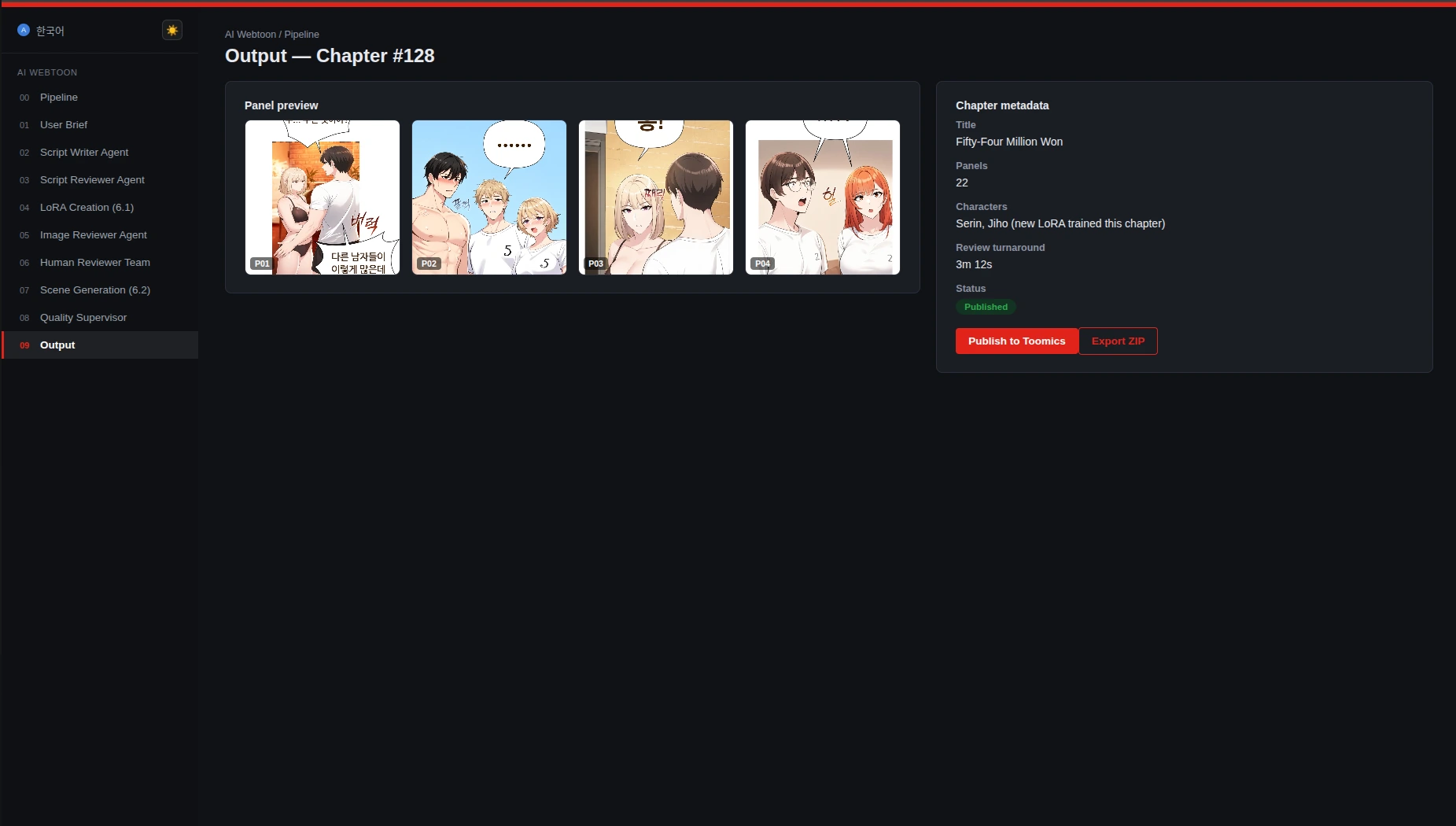
Joined panels ship as the finished chapter. The full run is observed by an LLMOps layer — turn-level tracing, a token/cost ledger, deterministic + LLM-judge eval suites, and a release gate for any prompt or model change.
User BriefScript Writer AgentStory contentDialogueScene promptCharacter sketch promptScript Reviewer AgentIMAGE GEN &TRAINING SYSTEMLoRA CreationImage Reviewer AgentHuman Reviewer TeamIMAGE GEN &TRAINING SYSTEMScene GenerationQuality Supervisor AgentOutput
01Multi-Agent Orchestration
02LangGraph
03LoRA fine-tuning
04ComfyUI
05Qwen Image Edit
06FLUX / SDXL / QWEN
07FastAPI
08RunPod
09Human-in-the-loop

03Sample output

Three finished chapters, rendered end to end by the pipeline — script, character art, and panel generation all produced by the system above.

All ages
16+Mature content

04Inside the AI Webtoon admin

The pipeline isn't just an API — the team operates it through an internal admin tool: a run view of the pipeline itself, plus a dedicated screen per agent for the parts that need human eyes (reviewing scripts, generating and QA-ing character sketches, training LoRAs, checking generated panels).
Pipeline run view
Pipeline
Live run view — script and character lanes, two merge points, two fail-loops back to the writer.
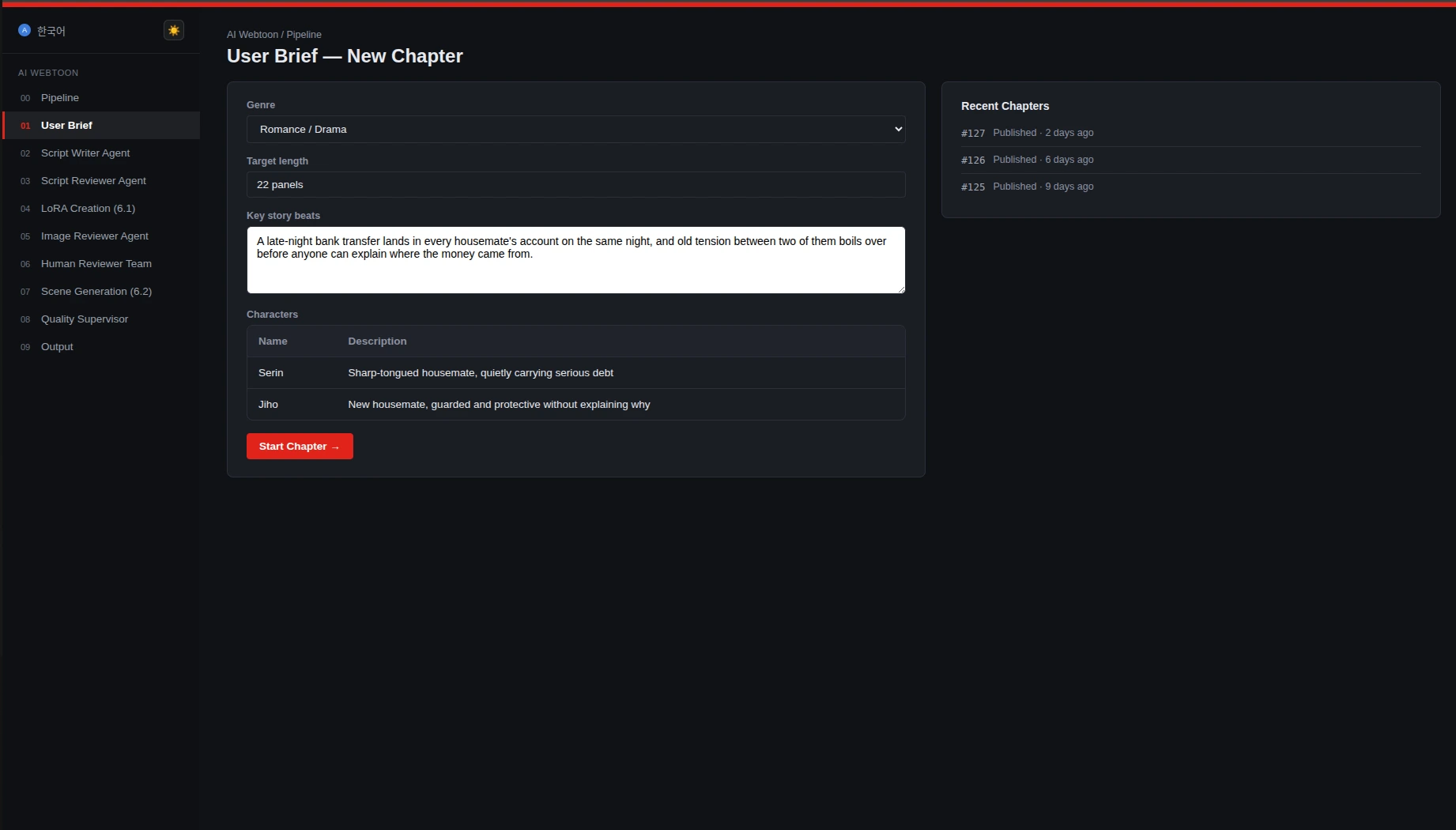
User brief form
User Brief
Where a chapter starts — genre, beats, characters.
Script Writer Agent screen
Script Writer Agent
One agent, four outputs: story, dialogue, a character sketch prompt, a scene prompt.
Script Reviewer Agent screen
Script Reviewer Agent
Rubric score on story + dialogue + scene prompts; fails loop back to the writer.
Character LoRA Creation screen
LoRA Creation (6.1)
Generates character sketches from the sketch prompt and trains the LoRA.
Image Reviewer Agent screen
Image Reviewer Agent
Automated pass/flag on the generated sketches before a human sees them.
Human Reviewer Team screen
Human Reviewer Team
The hard gate — script and character sketches approved together, or both sent back.
Scene generation screen
Scene Generation (6.2)
Renders panels from the trained LoRA, scene prompts, and dialogue.
Quality Supervisor Agent screen
Quality Supervisor Agent
Pass/flag per panel, drift caught before output.
Chapter output screen
Output
Finished chapter, ready to publish or export.

05Impact

Comic production time dropped from close to a year to a few months per series.
The platform secured multiple funding rounds and became a core product in the client's comic creation workflow.
Character identity stays consistent across hundreds of panels per chapter — the hardest part of production-grade generative AI for sequential art.